
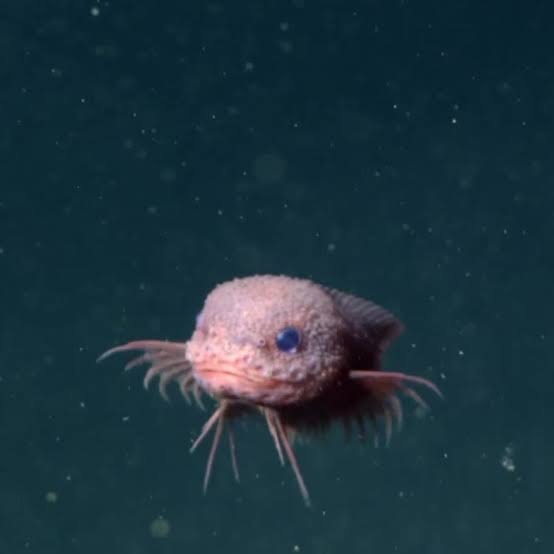
Researchers photographed Corydoras pumpi in dark, particle-filled water during a night survey of a deep river channel.
M. Ellison
Scientists just discovered Corydoras pumpi
No bigger than a thumb, this whiskered fish uses long barbels and a piercing blue eye to hunt in dark water.
In the silt-dark channels of a tropical river, most fish vanish into the murk long before a diver’s lamp can find them. Scientists working a night transect this year kept seeing something else: a small, armored shape hovering in the suspended particles, its face ringed with whisker-like barbels and one eye flashing an almost electric blue.
In a study published this month in Journal of Vertebrate Biology, researchers announced the discovery of Corydoras pumpi, a new species of tiny armored catfish. No bigger than a thumb, it is built for hunting where light barely reaches—relying on a spray of long facial barbels to feel for prey and a piercing blue eye to pick out motion in the gloom.
Hunting in the dark
Corydoras pumpi lives in slow, particle-filled water over fine mud. The water column looks empty until a lamp hits it; then the scene fills with drifting flakes of organic silt. That is the fish’s hunting ground. It holds station with small flicks of a compact tail, then walks the bottom with its pectoral spines the way other armored catfishes do—except this one often lifts off the substrate and hangs in the haze.
The barbels are the giveaway. A dense fan of tactile filaments radiates from the snout and jaw, each one packed with taste buds and pressure sensors. In water this turbid, vision is a backup system. “It is basically tasting the river with its face,” says lead author Amara Okonkwo, a freshwater ecologist who led the night surveys. “The barbels map the current. When a chironomid larva or a tiny crustacean bumps one of those filaments, the fish already knows where dinner is.”
The blue eye is not decoration. Under the lamp it reads as a dark sapphire disc, unusually large for a fish this small. Researchers think the oversized pupil and reflective layer behind the retina help the animal catch whatever stray photons still exist a few meters down. Combined with the whiskers, it is a two-channel predator: feel first, then confirm with a glance.
How they knew it was new
Okonkwo first photographed the fish in 2023 and assumed it was a juvenile of a known Corydoras already listed from the same basin. The armor plates looked familiar. The blue eye did not. After two more field seasons, the team collected a small series of specimens—handled under permit, photographed, and preserved—and compared them with museum lots from across the genus.
Anatomy told part of the story. C. pumpi has a shorter, rounder snout than its nearest relatives, more numerous barbels, and a distinctive pattern of bony scutes along the flank. DNA from mitochondrial and nuclear markers placed the fish on its own branch, well outside the clusters of described species. “You can have a hunch in the water,” says coauthor Piet Van Loon, an ichthyologist at the Naturalis Biodiversity Center. “The sequences are what make you write the paper. This was not a color morph. It was a lineage.”
The name pumpi is a nod to the way the fish seems to pulse in place—tiny, insistent, never quite settling—and to the pump of water across those barbels as it samples the current. Adults reach about 4.5 centimeters. They are armored, but the armor is thin, more like overlapping tiles than a tank. In the hand, researchers say, the fish feels like a wet seed with whiskers.
A tiny hunter with a wide range
Once the team knew what to look for, they found the species in several deep pools along the same river system, always where silt stayed in suspension and daylight faded fast. Citizen photographs later turned up similar faces in neighboring drainages. Color varies from pinkish tan to a duskier brown, but the blue eye and the radiating barbels are consistent.
Stomach contents, read from a handful of specimens, were mostly insect larvae and microcrustaceans—prey that hide in mud and only betray themselves by movement or chemical traces in the water. That diet fits the hardware. Long barbels drag a sensory net through the dark. The eye watches for a last-second flinch.
“It is easy to miss a fish that is the color of the river and the size of your thumb,” says Helen Park, an ichthyologist at the University of Washington who was not involved in the study. “The fact that we are still pulling new Corydoras out of well-traveled basins should tell us the inventory is nowhere near finished.”
Okonkwo’s group is already back on the water, this time with finer nets and a quieter lamp. They want to know whether C. pumpi spawns in the same silty channels or moves upstream when the rains come. For now, the fish remains what it was on that first night: a small, whiskered shape in the particles, staring back with one improbable blue eye.